[metaslider id=12]

By

Texsport Waffle Iron Review

DSC05971I like cast iron cookware.  The large cast iron frying pan that I use so much it usually just sits on the stove rather than getting tucked into one of the cupboards dates back to my grandmother and was produced in a foundry not far from here that is long gone.  Unless it gets thrown out it will be just as useful for one of my grandkids – now that’s longevity.  But a large part of why we see cast iron cookware stay around is because it isn’t just durable but functional.  That same large frypan is so well seasoned I have no problem baking thin crepes and can tell when the crepe is ready to flip by picking up the pan and tilting it – the crepe is ready when it starts sliding on the bottom of the pan.  You aren’t going to get a surface that slippery with stainless, and I doubt those fancy surface coatings like Teflon will be durable enough to last a decade let alone my lifetime.

Texsport Waffle Iron

Texsport Waffle Iron

So it’s into that matrix that the Texsport Waffle Iron enters into the mix.  Unlike the Teflon coated electric waffle irons this one will last generations.  Now is it good enough that your grandkids will list it among the things they want from your estate?  Yes – if you get it right.

The first part of getting the use of this waffle iron right is making sure it stays well seasoned.  A little oil goes a long way to building and maintaining that surface.  Unlike cast iron frypans and griddles the projections on a waffle iron make it very unforgiving if not properly seasoned – there is no cheating possible.

Whole grain waffles with barley flour

Whole grain waffles with barley flour

The other part of getting it right is making sure that you don’t treat this unit as if it is solidly held together.  Both sides of the iron come apart and the ring that hold the iron is free too.  When you flip the iron from one side to the other you need to hold the ring steady – I just use the dishtowel that usually hangs on my oven door since the ring does get hot.  You also need to hold onto the upper half of the iron when you open it up to put in the batter or to remove the waffle – don’t get lulled into thinking that you can lean it back and have it stay in place – it won’t.

In terms of what cooktops it works with – it works with induction tops, with resistance tops and I’ve even used it on propane camp stoves.

Would I recommend it?  Absolutely for less than $50 it’s a great buy, even if it only lasts five generations that’s still only $10 per generation – so pick one up and fancy up your breakfasts while acquiring a future heirloom.  Check this out for a great whole grain waffle recipe.

By

Grinding Cornmeal with the Homestead Grain Mill

Homemade Grain Mill

Homemade Grain Mill

One of the great advantages of having your own grain mill is being able to grind a huge assortment of grains – and grind them as fine or coarse as you want… You get to make the choices!

The homestead grain mill is great for grinding corn for cornmeal or corn flour – but not masa… it’s a dry mill and not intended for grinding nixtamatal.  If you are going to do that – and you should – pick up a masa mill – they are very cheap.

Freshly Ground Cornmeal (R) beside Whole Wheat Flour (L)

Freshly Ground Cornmeal (R) beside Whole Wheat Flour (L)

But back to grinding corn for cornmeal or corn flour.  Now compared to grinding small grains there is one tweak you need to do in order to have a reasonable production rate.  You need to start with a greater gap between the burrs to accommodate the larger grain size.  That’s it… really that simple.  So add some whole grain corn to your larder and start using it in your baking.

So if you don’t have a mill, why not consider building one – it’s going to be much easier than you probably are contemplating, and it will leave you with the skills to tackle loads of additional projects that will likewise yield independence dividends around your home and homestead.


By

Egg ‘n Ham Breakfast Bagels – breakfast on the go done right

Let’s give credit where credit is due.  Fast food gets loads of flack including the blame for making folks fat.  But consider that McDonalds – the quintessential fast food chain has been around for decades – including a whack load of time during which folks were in pretty good shape.  No question the portion size has a bunch to do with it as well as the frequency of a patron’s visit – but those are in the full dominion of the patron.

Ham and Egg breakfast bagel - whole wheat

Ham and Egg breakfast bagel – whole wheat

OK, so  where am I going with this – well to some of the fast food breakfast offerings.  Not only did the introduction of these mark a capital utilization and financial breakthrough for the fast food joints but also in many respects created many new food  items in the form of breakfast sandwiches.  Moreover, those breakfast sandwiches are great!

But just like you can make a better burger at home you can also upgrade the breakfast sandwiches by making them chez vous.  In my home I know that whenever I make up a batch of whole wheat bagels (which are so simple that you need to try them now) I had better have cream cheese and a fillet of our home smoked salmon or trout as well as eggs so that I can make bagels with lox and then breakfast egg bagels if any last to the next morning.  Failure to properly plan ahead – or at least warn the other occupants of the house that some component is missing (usually we’ve eaten though all of the smoked salmon) – will trigger a cascade of complaints.  And this is for something that is whole grain and pretty healthy no less.

So what are you waiting for?  Take the food you love from out there and make it better at home – starting with whole wheat bagel breakfast sandwiches.

By

Grind it fine – whole grain flour

In real estate the three factors that are said to matter are “Location, Location, Location”.  A similar thing might be said of baking – the secret is all in the ingredients.

So, it’s somewhat surprising then when folks use whole grain flour that has the consistency of sand and wonder why their whole grain baking doesn’t match up with what they can produce with the super fine white flour.

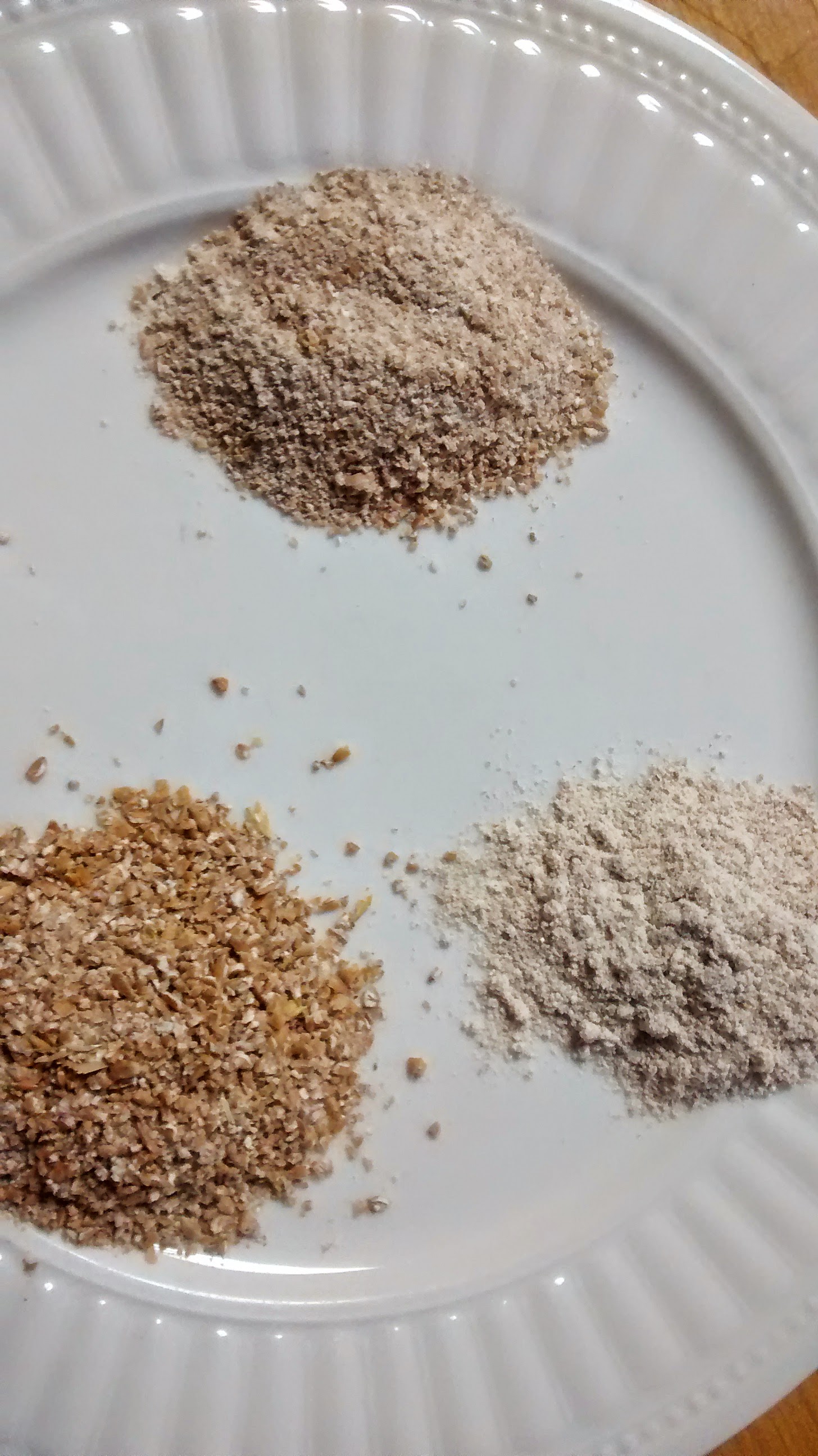
Whole grain flour Lower Left - Cracked Top - Second pass Lower Right - Pastry fine

Whole grain flour
Lower Left – Cracked
Top – Second pass
Lower Right – Pastry fine

Really?  It’s all in the ingredients, so when starting with a coarse flour it is hardly surprising that you get a coarse product.

The homestead mill will produce pastry fine flour – and that is the grade that I aim to produce and use in all of my baking.  If anything using fine flour is more important with whole extraction flours than with white since the lower proportion of gluten in whole grain flour and the slower absorption of liquid due to the higher fiber content benefits significantly from the smaller particle size.

Now, I think that one of the reasons folks go coarse is because they expect to produce suitable flour in one pass through the burrs.  I guess that with a tiny mill it might be possible enough to muster the torque to produce that quality

of flour in a single pass – but you certainly wouldn’t be doing it very quickly.  As soon as you step up the burr size that becomes nearly impossible.  Move up to a six inch burr like those on the Homestead Grain Mill and you’re up for a real challenge.

Instead of struggling to do it in one pass I usually do it in at least two passes, and more often three.  The first pass is just to crack the grain, the second brings it down to a much finer but still cracked consistency, with a third pass to get it pastry flour fine.  If I  am using the power drive I usually end doing the reduction in four passes.

With finely ground flour I think you’ll find that your whole grain baking gains a whole new level of endorsement from your family and friends.


By

Why get a grain mill

So why would you want a grain mill to produce whole grain flour at home?

Well, I can share a few of the reasons why I value my grain mill.

First, I like the health benefits offered by whole grain, 100% extraction flours.  By producing my own whole grain flour at home I can get everything that is in those seeds and put it in my baking.  I can’t easily buy 100% extraction flour, in part because once the endosperm is ground the oils in the seed start to go rancid.

Second,  I like the financial advantage of baking at home. I can bake a loaf of bread for a fraction of the price of a white loaf from the store – let alone the cost of a premium priced whole grain loaf.  That financial savings is a nice gain especially since it comes not from sacrifice but from a significant gain.

Third,  I like being able to purchase and store whole grains.  Not only can I purchase them in bulk for a fraction of the price of white flour from the store but I can also purchase them at low cost and avoid price fluctuations and provide a hedge against my own income disruption.

Now, let’s be honest.  It does take time to grind grain.  But, if I don’t feel like hand cranking out a loaf worth of flour I can always use my power drive, and quite often grind enough for a couple of days.  Combine the power drive for the grain mill with a bread machine and mechanization does most of the work.

I also find it’s a pain to have to head out to the grocery store to pick up a loaf of bread, and would take considerably more time than producing flour and baking at home.

In my home home ground wins hands down and it has for over a decade.